JD Sports reports that revenue from on-site search has risen 22% since it added Algolia to its tech stack in 2024, and click-through on its product listing pages has risen 73%, according to Digital Commerce 360 in September 2026.
The figures come from an announcement by JD Sports and Algolia, the search vendor, and the report gives changes since 2024 without starting values.
Before
JD Sports runs more than 4,800 stores worldwide and has more than 9 million active loyalty members, according to the report. It added Algolia to its tech stack in 2024. The report gives no starting figures for search or listing pages, only how much they changed afterwards.
What they changed
- Moved on-site search and product discovery to Algolia. This happened in 2024 and is the change the reported gains are measured from.
- Made the same system the base for AI shopping agents. In September 2026 JD Sports named Algolia its "governing intelligence layer" for agentic commerce, so AI assistants can find and shop its products through the same catalog data.
- Treated product data as the thing agents read. The announcement argues that a shopping agent cares whether the catalog data it retrieves is right, more than how fast a search box responds.
After
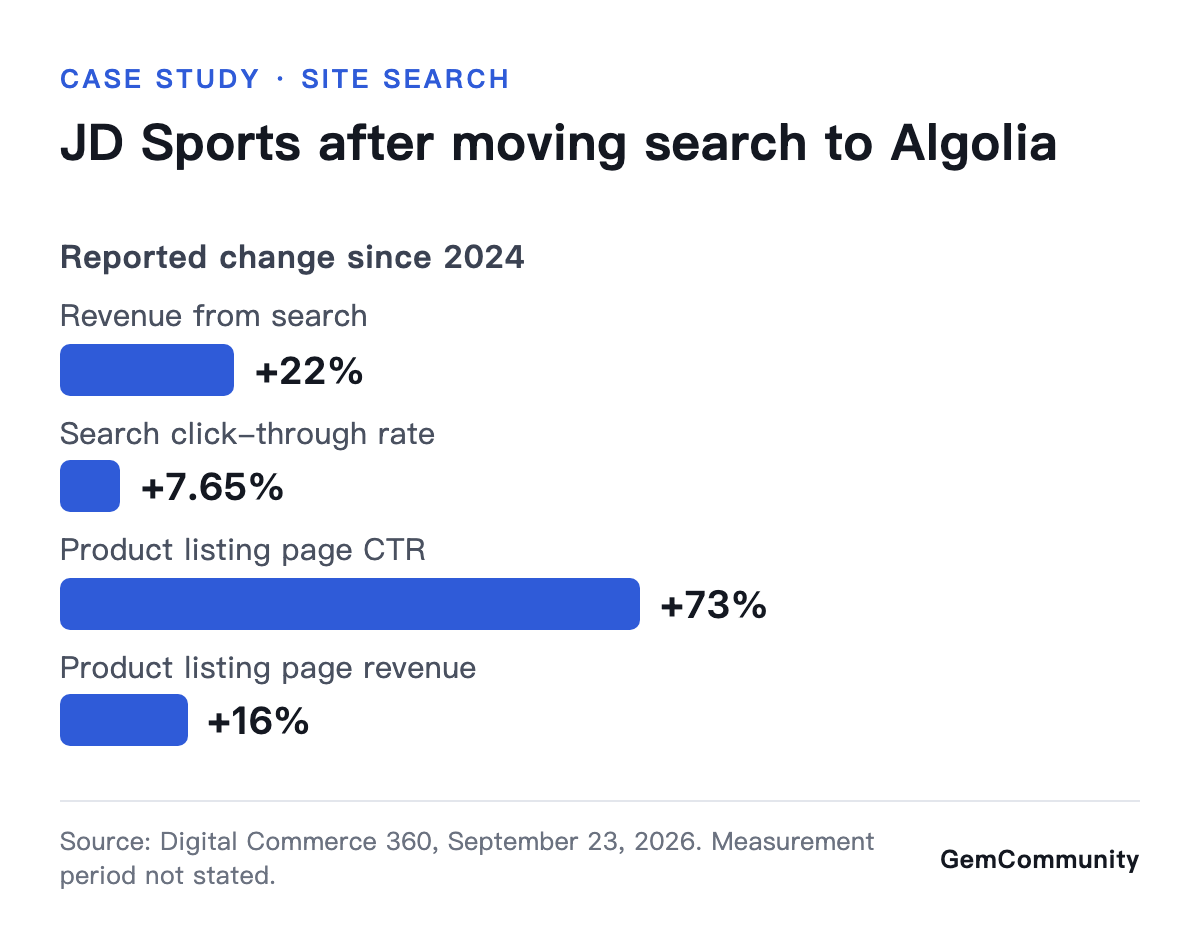
| Metric | Change since 2024 |
|---|---|
| Revenue from search | +22% |
| Search click-through rate | +7.65% |
| Product listing page click-through rate | +73% |
| Product listing page revenue | +16% |
These are reported changes from a large retailer with its own data and engineering teams. The report does not say over what exact period they were measured or what else changed on the site at the same time.
How can you test this on your store?
- Split your analytics so you can see revenue from sessions that used on-site search separately from the rest.
- Record four weeks of baseline numbers for search revenue, search click-through, collection page click-through and collection page revenue before you change anything.
- Pull your top 50 searches, check which ones return poor or zero results, and fix the product titles, tags and attributes behind them.
- Change one thing at a time, such as search settings or collection page layout, and compare against your baseline.
- Review whether your product data answers the questions a shopper or an AI assistant would ask, because both read the same catalog.
Frequently asked questions
What is a product listing page?
A page that lists several products, such as a category or collection page. On Shopify it is usually a collection page, and its click-through rate is the share of visitors who open a product from it.
Who reported these numbers?
JD Sports, in a joint announcement with Algolia that Digital Commerce 360 reported. Algolia sells the software, so the numbers come from the customer and the vendor, not from an independent test.
Would switching search tools lift my revenue by 22%?
The report cannot tell you that. It covers one large retailer, gives no baseline and no exact time window, and other changes may have happened in the same period. Measure your own search revenue first, then test.
Sources
- Digital Commerce 360: JD Sports deploys Algolia for agentic commerce strategy